
















Fart Together












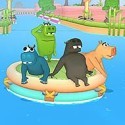
You lean into the gas at the exact moment your friend leans the other way, and the raft spins into a wall instead of the gap you were both aiming for. That single mistimed push is the whole idea behind Fart Together, a physics-based obstacle course where two to four players share one raft and every burst of gas belongs to the entire crew. The game rewards the group that fires together instead of the player who pushes hardest, and it hands everyone else a very public lesson in blame.
| Genre | Physics-based co-op obstacle course |
| Players | 2–4 in co-op, up to 8 in Team Race |
| Core Challenge | Steering one shared raft through tight courses with gas power |
| Content Length | Roughly 4–5 hours, depending on team coordination |
How Gas Power Moves the Raft in Fart Together
Every player on the raft controls three things at once: direction, timing, and gas. Nobody owns the steering, so the raft answers to the combined force of whatever the crew does in the same instant. Two players pushing the same way produce a clean burst forward, while two players pushing against each other leave the raft twitching in place. That is why the motto of the game, that the secret is farting together at the right time rather than farting harder, sounds like a joke and works like a rulebook.
Beginners almost always treat gas as a speed button.
Spamming gas feels productive for the first few seconds, and the wide stretches early in a course forgive it. Once narrow passages and sharp turns start stacking up, a raft carrying too much momentum cannot be corrected by anyone, and the whole crew watches it slide past the gap. The physics are described by the game itself as only sort of realistic, which is an honest warning, because the raft sometimes reacts in ways nobody in the group can explain, and arguing about why becomes part of the routine.
Where Co-op Runs Fall Apart on the Course
The course throws four kinds of trouble at the crew: narrow passages, sharp turns, moving obstacles, and hazards that knock the raft off balance. Each one exposes a different weakness. Narrow passages punish over-correction, sharp turns punish a late call, and moving obstacles punish whoever commits before the group does. By the time the moving obstacles show up, crews that talked through the opening stretch are already pulling ahead of crews that treated it as a warm-up.
Silence ruins more runs than bad aim ever does.
Players have their own vocabulary for the damage. Someone always tipped the raft, someone else started it, and the store page itself jokes that the game may record who tipped the raft but never who started the argument. Groups that enjoy shouted chaos will find the pull of one more try hard to resist, while players who want clean, quiet runs may tire of shared control after a few failed attempts. Humor built on fart jokes is also a matter of taste, and the game does not pretend otherwise.
Timing Habits That Keep the Raft on Line
Crews that finish courses cleanly usually settle on a few shared habits, and none of them are secret techniques. Almost every struggling group skips at least one of them, which is why the same turn can take one team thirty seconds and another team a whole evening.
- Name one caller for each turn so the crew hears a single voice instead of four.
- Agree on a direction before anyone touches the gas, then fire on the same count.
- Use short bursts through narrow passages instead of one long push.
- Slow down on purpose before a sharp turn, since the course asks for restraint as often as it asks for speed.
Players who like to take charge usually end up as the caller, and the role suits them because a decisive voice matters more than a perfect read of the physics. The quieter player at the back often turns into the most reliable finisher, since landing the last correction on the count matters more than shouting it.
Corrections are where good groups separate from chaotic ones. A raft that is already drifting needs one small, agreed adjustment, not four separate fixes arriving at once. Teams that learn to stop pushing together for a moment, let the raft settle, and then restart on a fresh count recover from mistakes that would otherwise end the attempt.
Team Race: Two Rafts, Eight Players, One Course
Team Race splits up to eight players into two teams that race their rafts through the same obstacle course, with the finish line as the only goal. Standard co-op asks a crew to beat the course, while this mode asks a crew to beat the other raft, and that changes how much risk a team is willing to take on a tight turn.
Four voices on one raft is already plenty, and once a rival raft is in view, calm calls tend to turn into panicked ones. Competitive players who normally skip cooperative games will find Team Race the more natural fit, because the rivalry gives every mistimed push a visible price.
The raft physics stay the same in this mode, so a team that dominated the co-op courses can still lose to a rival raft that bounces off the right wall at the right moment. Some players enjoy that swing, and others call it unfair, which is a fair split of opinion for a game built on unpredictable physics.
Questions Players Ask Before Starting Fart Together
How many players can share a raft?
Co-op supports two to four players on one raft, and Team Race stretches that to eight players split across two rafts. Each player controls direction, timing, and gas, so group size changes how the raft behaves more than any single course does.
How long does it take to finish everything?
The content in its current state runs roughly four to five hours, depending on how well a team coordinates. Groups that spend their time arguing about the raft physics will land at the longer end, because one tricky turn can eat many attempts.
How do you stop the raft from spinning out of control?
Agree on a direction before anyone fires, then use short bursts on the caller’s count. Spinning usually means two players are pushing against each other, so cutting the gas for a moment and resetting the raft’s heading beats pushing harder.
Fart Together is at its best when a crew stops blaming the raft and starts listening to the caller, because the courses reward a shared count far more than raw force. The tight passages, the sharp turns, and the rivalry of Team Race all point to the same lesson, and the friends who learn it fastest are usually the ones laughing hardest while they drift into the next wall.
Comments
There are no reviews yet. Be the first one to write one.
