















WILDERLOCKE











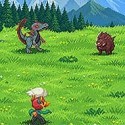
What happens when one careless turn costs you a monster for good? In WILDERLOCKE the answer is simple and harsh: that monster is gone for the rest of the run, and if your whole party falls, the run ends. The game blends the high-stakes rules that Nuzlocke challenges made famous with the unpredictability of a roguelike, then adds tactical 2v2 turn-based battles where nothing is left to chance.
| Genre | Tactical monster-taming roguelike |
| Players | Single-player |
| Battle Format | Turn-based 2v2 |
| Roster | 100+ monsters to discover and evolve |
| Customization | 4 moves and 2 passives per monster |
Nuzlocke Pressure Meets Roguelike Runs in WILDERLOCKE
Nuzlocke is a community-born ruleset for monster-taming RPGs in which a monster that faints is lost permanently. The game borrows that tension directly: lose a monster in battle and it is gone forever, lose all of them and the run is over. Each attempt then assembles a different combination of opponents, encounters, and monsters, so no two runs follow the same script and memorizing a route is not an option.
Beginners tend to treat monsters as disposable early on.
Early in a run it is tempting to push a weak monster forward just to see what a fight looks like, and that habit ends more runs than any single boss party does. Veterans of Nuzlocke challenges will already know the instinct to protect the team first, but the roguelike structure adds a new layer, because a lost monster also changes which strategies are even available for the next encounter.
Building a 2v2 Party Around Four Moves and Two Passives
Every monster carries four moves and two passives, drawn from a pool of more than 250 moves and more than 80 passives across a roster of over 100 monsters. That scale is what makes synergies the heart of the game, since a pair of monsters can cover each other’s weaknesses or stack effects that neither could manage alone. Because battles are always 2v2, the partner standing beside your lead matters as much as the lead itself.
Before committing a pair to a fight, a few checks keep a party honest:
- Does the second monster cover the weakness of the first?
- Do the two passives support one plan or pull in opposite directions?
- Is there an answer ready for a status effect that could stall the whole pair?
The sheer number of options is also where the game can overwhelm newcomers. Players who enjoy theorycrafting will lose hours in the move and passive pool, while those who prefer quick decisions may find the early party choices heavy until a few synergies click.
Stat Splits That Turn One Monster Into Two Different Roles
Half of a monster’s stats depend on its species, and the other half are set by you. That single rule means the same monster can be built as a supporting tank in one run and as a fast damage dealer in the next, depending on what the rest of the party lacks. Min-maxers will see this as the real depth of the game, because the roster is only the starting material.
Evolution adds another decision point, since a monster that grows stronger also changes what job it can safely do. Tanks that soak hits for a partner and fast attackers that finish fights before they begin both depend on those stat choices being made with the whole team in mind.
Players who like predictable builds can repeat what worked, but the roguelike structure keeps pushing them toward new combinations. A stat spread that carried one party may be wrong for the next, and recognizing that early is one of the quiet skills the game teaches.
Weather, Field Conditions, and Battles Without Dice Rolls
There is no randomness in battle: no critical hits, no chances to miss, and no moves with random secondary effects. That makes every fight solvable on paper, and every loss traceable to a decision you can name. Tacticians who dislike luck will love that clarity, because a failed run is never blamed on a bad roll.
The same design will divide players. Those who enjoy comeback moments from a lucky critical hit will miss them, and a run lost to your own misplay can feel harsher than one lost to chance.
Field conditions such as weather become the main lever instead. You can adapt to conditions that already exist or set them yourself to favor your plan, and the winning approaches vary widely: protect and strengthen one monster, apply crippling status effects, stall and win through damage over time, or simply hit harder and faster. Choosing a plan before the first turn is what separates a clean win from a scramble.
Boss Parties and Difficulty Levels in WILDERLOCKE
The game features more than 12 different bosses, backed by over 48 handpicked parties, each fight carrying its own battle modifiers. By the time the first boss parties appear, the rewards of a well-built pair become obvious, because these opponents are designed around specific strategies rather than random stat blocks.
Winning runs with your favorite monsters unlocks them as starters, which gives progress a meaning beyond a single attempt. Once new starters open up, the opening turns of each run shift, and a monster you once leaned on mid-run can become your first pick.
On top of that, there are more than ten difficulty levels, built to challenge even the most experienced trainers. That ceiling will draw players who want a real test, while casual players may bounce off the higher levels, and the game does not apologize for it.
Questions Players Ask About WILDERLOCKE
- How does WILDERLOCKE differ from a regular Nuzlocke challenge? A Nuzlocke is a self-imposed ruleset layered on top of an existing monster-taming RPG, while this game builds permanent loss directly into a roguelike structure. Every run generates new opponents, encounters, and monsters, and the 2v2 battle system is designed around that pressure.
- Is there any randomness in battles? No. There are no critical hits, no chances to miss, and no random secondary effects on moves. Outcomes depend on your party, your passives, and the field conditions, so the planning you do before a fight decides the result.
- How many moves and passives can a monster carry? Each monster holds four moves and two passives. Half of its stats come from its species and the other half are set by you, so the same monster can fill a supporting role or a damage role depending on what your party needs.
WILDERLOCKE turns every lost monster into a lesson, because with no dice rolls to hide behind, the fault always sits with a decision about passives, partners, or field conditions. Players who survive long enough to meet the boss parties and unlock new starters will feel that pressure pay off, and the ones who fall will already be planning the next run.
Comments
There are no reviews yet. Be the first one to write one.