









Pickochet











Two of Pickochet’s six mining locations are unlocked in the current build, and most players clear both in a single sitting before circling back to grind out the upgrades they skipped the first time. That loop is what keeps people opening Pickochet again after they think they are done with it: throw pickaxes, watch them ricochet off rock walls, and let the resulting chaos chip away at ore while you decide how hands-on you actually want to be.
| Genre | Incremental mining / idle-clicker hybrid |
| Core Mechanic | Ricocheting pickaxes that auto-mine ore on impact |
| Mining Locations Available | 2 of 6 (current demo build) |
| Ability Loadout | 3 equippable slots, hotkeys 1-3 |
| Upgrade Trees | Ores, Pickaxes, Abilities (separate tabs) |
How the Ricochet Mining Loop Works
The first few minutes of Pickochet are almost deceptively quiet. Throw a pickaxe and it bounces between rock faces and ore veins, chipping off resources without another click needed, and left alone the pickaxes keep ricocheting on their own. That is why players describe the early game as something you can genuinely walk away from. But click along with the bounces, timing your own throws between the automated ones, and the resource counter climbs in a way idle ticks alone never quite match.
Spending what you earn requires ending the run first. You cannot mine and immediately buy an upgrade in the same session; currency only becomes usable back at the hub between mining locations. Some players like the clean start-and-stop rhythm this creates. Just as many find it disruptive, since a strong ricochet chain often has to be abandoned right when it starts paying off, purely so the resources can actually be spent.
Layout matters more than it first appears. The two accessible locations already play differently from each other, a tighter cave rewarding different pickaxe choices than a wider open dig, and players who clear both tend to agree that the four still-locked sites are the main reason they keep checking back.
Fire in the Hole and the Rest of the Ability Bar
Once the ability system opens up, Pickochet stops being just a physics toy. You get three slots, and what fills them changes a run completely. Fire in the Hole is the ability players bring up most often, a burst that detonates a cluster of ore in one go instead of waiting for a pickaxe to wander over, and it is usually the first ability new players fall for because the payoff is immediate. Crit dice roll works differently, giving every ricochet hit a chance at a multiplied payout, the kind of swingy mechanic that keeps eyes on the screen. The screen-clearing ultimate is the one people talk about most: a small wizard walks onscreen and casts a sprawling, colorful cluster of explosions across the mining area, wiping out everything remaining in one animated flourish.
Because there are only three slots, picking the wizard’s screen-clear usually means giving up either Fire in the Hole’s targeted burst or Crit dice roll’s steady value, and the right mix shifts as a location fills up or thins out. The ability bar is also where the game’s personality shows through most; the animations have real character, and reviewers consistently single them out as more polished than the menus surrounding them.
None of this happens in isolation from the pickaxe you are carrying. A gem-focused pickaxe that stacks bonus damage for every adjacent gem, reportedly dealing up to 51 damage on a fully stacked swing, pairs differently with each ability than the currency-focused pickaxe players nickname the money axe, which converts hits into spendable resources rather than raw mining power.
Three Upgrade Trees and the Pickaxe Store
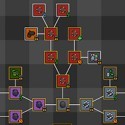
Progression splits across three trees, ores, pickaxes, and abilities, each on its own tab in the hub menu. The pickaxe store, where variants like the gem pickaxe and money axe are bought, is one of the systems the tutorial explains the least, and more than one player admits to missing it entirely on a first playthrough. Tutorial text also has a habit of skipping past too quickly right as a new area opens up.
Timed content adds another layer. The Dwarf Rush event shows up as a limited opportunity that rewards players who already stocked the right materials, and at least one player has reported struggling to trigger it despite seemingly meeting the requirements, suggesting the conditions are stricter than the game lets on.
Splitting progression into three tabs makes conceptual sense, since ores, pickaxes, and abilities really are different systems. In practice it is one of the more common complaints in the comments: players want to compare upgrades across all three trees at once instead of tabbing back and forth, and several have suggested consolidating them into a single connected map.
Where Pickochet Still Divides Players
Ask around and you will find real disagreement about difficulty. A good number of players call the demo too easy once you understand the ricochet-and-upgrade loop, with no scaling pressure past that point, and they are hoping the full six-location version leans harder into escalation. Others are happy with the relaxed pace, treating Pickochet closer to a traditional idle-clicker that runs in the background rather than something demanding full attention.
The interface is the other recurring sticking point. Gameplay systems get consistent praise, but the menus wrapping around them are frequently described as functional at best, lacking the personality the ability animations have in spades. That gap between a lively core loop and a plain shell around it is the single most repeated criticism across reviews and comments alike.
None of this stops people from returning. Casual players treat it as a five-minute pickup, theorycrafters spend real time optimizing which three abilities pair best with which pickaxe, and idle-focused players just let the ricochets run while doing something else. Pickochet accommodates all three without forcing anyone into a playstyle they did not choose.
Questions Players Keep Asking
Do the pickaxes ricochet in a fixed pattern, or is it randomized?
It reads as physics-driven rather than scripted. The angle a pickaxe leaves a surface at depends on where it lands, which is why players who aim carefully can chain bounces through dense ore clusters more reliably than someone flinging them blindly.
Why do I have to end a run before I can spend what I earned?
It is a deliberate structural choice. Currency earned during a run only becomes spendable back at the hub between mining locations, giving runs a clear start and stop point, even though many players would rather spend and keep mining without breaking the loop.
Is there more content past the two mining locations in the demo?
The demo caps out at 2 of the planned 6 total locations. Players who clear both generally spend their remaining time optimizing ability and pickaxe combinations, including chasing the Dwarf Rush event, rather than finding new areas to explore.
Pickochet earns its keep on a genuinely satisfying core idea: pickaxes that bounce, chip, and detonate their way through ore while you decide how hands-on to be. Between Fire in the Hole’s instant gratification, the wizard’s screen-clearing flourish, and the still-unresolved friction of ending a run just to spend what you mined, it is a demo with more personality in its mechanics than in its menus.
Comments
There are no reviews yet. Be the first one to write one.