















Mini Motorways












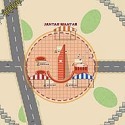


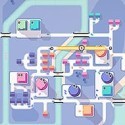
Mini Motorways looks like a gentle toy-box city builder and plays like a nonstop traffic-triage exam. Pastel houses appear, colored destinations follow, and your only tool is a limited supply of road pieces. The calm look is the trap: every new building is another demand on a network you drew a few minutes ago. What follows covers how the system works and where runs usually fall apart.
| Genre | Puzzle strategy |
| Goal | Connect colored houses to matching destinations |
| Perspective | Top-down |
| Core tool | Drawing roads |
| Mode | Single-player |
Colored Houses, Destinations, and Pins in Mini Motorways
The core loop is simple to describe. Houses spawn in a color, destinations of the matching color spawn elsewhere, and you draw roads so cars can travel between them. Each house sends cars to its matching destination, and when those trips are not completed fast enough, pins pile up over the destination. If the pins overflow, the run ends, which makes the pile of pins the most important thing on the screen.
Beginners usually build one long road and try to route every color through it. That works for a few minutes, then a single junction starts carrying traffic for three different destinations and everything slows down. Players call the result spaghetti, and it is the most common reason early runs collapse.
Terrain pushes back as well. Water and other obstacles force detours, and your supply of road pieces is limited, so every tile you spend on a bad route is a tile you cannot spend later. Once the first weekly upgrade arrives, the game starts to feel less like drawing and more like budgeting.
Weekly Upgrades: Motorways, Roundabouts, Traffic Lights, and Bridges
Each week brings fresh road pieces and an upgrade to choose from, and the choice shapes the whole run. The names players use most are:
- Motorway: a fast, high-capacity road that suits long hauls between distant clusters.
- Roundabout: a junction replacement that keeps cars moving instead of stopping to give way.
- Traffic Lights: a way to control a busy crossing that would otherwise lock up.
- Bridge: a way to cross water or another road without a detour.
Choosing between them is where the arguments start. A Roundabout placed early can fix a junction that would have become gridlock three weeks later, while a Motorway placed too early can sit unused. Perfectionists on forums often plan upgrades around the next two or three weeks instead of the current one.
The offered upgrades are not always the ones your layout needs, and that randomness is a real point of friction. Players call it upgrade roulette, and a bad draw at the wrong moment can end a run that was otherwise clean.
Gridlock and Spaghetti: What Actually Ends a Run
Gridlock almost never starts where it becomes visible. The pins grow over one destination, but the cause is usually a shared junction several tiles away that carries cars for two or three colors at once. The fastest fix is to give each busy color its own route, even if that means tearing up a road you were proud of.
When to use a Roundabout instead of Traffic Lights is a question every player asks. A common rule is to use a Roundabout where cars arrive from several directions at a steady rate, and Traffic Lights where one road clearly dominates. It is a rule of thumb, not a law, so test it on your own layout.
A fair complaint is that late-game collapse feels close to inevitable. Houses and destinations keep spawning faster than any layout can absorb, and where they appear is partly luck. Players in Endless runs treat the collapse as the scoreboard rather than a failure, since your score reflects how long the network held.
Layout Habits That Keep Mini Motorways Runs Alive
Experienced players build a spine road early, a main route that leaves room for branches on both sides. Branches then feed the spine instead of crossing it, which cuts the number of junctions that can jam. Leaving empty tiles next to busy roads is a habit most beginners skip, and it is the one that saves the most runs.
Another technique is to erase and redraw before a road breaks, not after. Cars are still moving, but a network you rebuild at the first sign of pins is far cheaper than one you rebuild in panic. Chill players who treat the game as a relaxing puzzle often ignore this, and they are the ones who watch a run end suddenly.
Spacing matters too. A destination tucked behind a crowded junction will fill with pins faster than one with its own approach. Giving each new destination a clean entry the moment it appears is a small discipline that compounds across weeks.
Why Another Run Keeps Starting After a Collapse
Your score tracks how many trips you completed, so every run produces a number you can try to beat. Because the layout is partly random, no two runs share the same crisis, and that variety is what keeps people replaying. A collapse rarely feels unfair for long, since you can usually name the junction you should have rebuilt.
Daily Challenge fans compare how the same setup played out for different players, which turns a solo puzzle into a shared one. Seeing someone else solve your exact crisis with a single Bridge is humbling and instructive at the same time.
The honest downside is that the difficulty curve can feel steep. Players who want pure relaxation sometimes hit a wall around the point where pins stop clearing between weeks. Those who enjoy the pressure treat that wall as the best part.
Mini Motorways rewards players who keep their roads simple and their junctions few, with a Roundabout where traffic converges and a Motorway where distance is the problem. Watching the pins above each destination is the whole skill, and the weekly upgrade choice is where a run is won or lost. The game stays easy to start and hard to finish, which is exactly why one more run is always tempting.
Comments
There are no reviews yet. Be the first one to write one.