















Poopy’s Playland







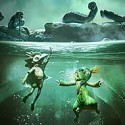

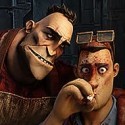

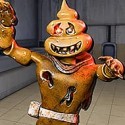
In Poopy’s Playland you begin as a grieving mother standing at the edge of a playland that has been abandoned for one year, holding a flashlight and very few answers. Your child went missing here, the doors have been shut ever since, and you are going back in because the truth matters more than the dark.
| Genre | First-person mascot horror with puzzles |
| Mode | Single-player |
| Setting | An abandoned playland |
| Core tools | Flashlight and a controllable companion friend |
| Style | Realistic visuals with ray-traced reflections |
A Mother, a Flashlight, and an Abandoned Building: How Poopy’s Playland Starts
The story is set up around a single question: what happened to your child one year ago? You break into the playland where kids once came to play and have fun, and the place is still full of play-structures and games that now look very different without any light. The flashlight is your main way of seeing, so every beam you aim is also a choice about what you leave in the dark.
The first-person view keeps you close to the building. Smoothly transitioned first-person cutscenes mean the story is delivered without cutting away from your eyes, and ray-traced reflections give wet floors and glossy surfaces a realism that suits a setting built to look cheerful. The contrast between colorful play equipment and a ruined, quiet interior is a large part of the appeal.
As the tags suggest, this is as much an investigation as a horror game. You explore, operate tools and items to unlock new areas, and piece together the mystery. Players who like a slow, clue-driven story will get more out of the setup than those who only want constant action.
Replayable Puzzles That Rearrange Themselves
The puzzles are the feature the store page pushes hardest. They are described as replayable, and they change dynamically in each playthrough, so a solution you memorize the first time will not simply work the second time. That makes the playland feel less like a fixed level and more like a lock that gets re-cut every time you return.
The main effect is that you cannot rely on a walkthrough. Puzzle fans who enjoy actually reasoning through a solution will see this as a plus, since the answer comes from observing the room rather than recalling a code from a video. It also gives you a reason to start over once you have found out what happened.
Most of these puzzles are tied to tools and items you pick up as you go, which gate access to new areas. Early in the game, expect to spend more time looking than acting, and do not be surprised if you walk past the answer once before noticing it. The best habit is to treat every new item as a question about where it fits.
Hiding From the Killer Mascots and Robots in the Dark
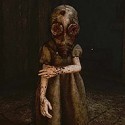
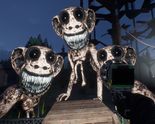
The threat in the playland comes from unstable killer mascots, and the store page also tells you to avoid being caught by the robots. Neither can be fought on equal terms, so the answer to danger is to sneak around the playground in the dark and hide. The stealth tag is a good summary of how most encounters work.
The flashlight creates a tension of its own. You need light to read the room and solve the puzzles, but a lit beam in a dark building is also the easiest way to be noticed. Stealth fans will enjoy deciding when to switch it off, and when the risk of walking blind is the better option.
There are also quick-time events and physics-based interactions, which add moments where reaction matters as much as planning. Once a mascot is close, the quiet, careful rhythm of exploring turns into something much more urgent, and learning to recover from that change of pace is part of the challenge.
Where Poopy’s Playland Divides Players
The game currently holds a Mostly Positive rating, with 76% of its 60 reviews positive. That is a solid result for a small project, but it also means a real share of players are not fully satisfied. The store page does not spell out specific complaints, so it is wise to treat the score as a reason to read recent reviews rather than as a final verdict.
The credits thank playtesters for making the game less buggy and more fun, which is a reminder that this is an independent project. Mascot horror is also a crowded genre, and the developers describe their approach as a take on it that has not been seen before. Whether that claim holds up depends on how much you value the grieving-mother story over familiar jump-scare formulas.
Quick-time events and stealth sections tend to split audiences in general. Some players enjoy the pressure, while others find it interrupts the investigation. Knowing which side you are on will tell you more about whether the game suits you than any rating.
Poopy’s Playland Questions Players Ask
- Do the puzzles stay the same on every playthrough? No. They are described as replayable puzzles that change dynamically each time, so you cannot rely on memorized answers. You will need to observe the playland again and work out what each tool or item is for.
- How do you survive the killer mascots? You cannot confront them directly. The game is built around sneaking through the dark and hiding, so using your flashlight sparingly and staying out of sight is the main way to avoid being caught by the robots and mascots.
- Is there a companion? Yes, the store page lists a controllable companion friend among the features. It gives you another way to explore, and it fits the idea that you are not entirely alone in the abandoned playland.
A flashlight beam, a companion friend you can control, and the unanswered question of what happened to your child are what give Poopy’s Playland its identity, and they are best appreciated by players who want a mystery as much as a scare.
Comments
There are no reviews yet. Be the first one to write one.