
















Punch the Walls














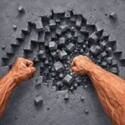
What do you do when the only things in your cell are a thick wall and your own fists? Punch the Walls answers by letting you break the stone into chunky cubes, vacuum up the rubble and turn it all into cash. Somewhere inside almost thirty metres of rock hides the code to the door, and the game wants you to dig until you find it.
Cubes, Vacuum, and Shredder: The Loop in Punch the Walls
You wake up in a concrete cell with nothing but your fists, and the walls are almost thirty metres thick. Every punch breaks the wall into cubes, so the hole you carve is a real hole and not a health bar ticking down. You then vacuum up the cubes and feed them to the shredder, which turns them into cash. The whole game rests on that three-step chain.
Cash goes straight back into harder fists and a bigger vacuum, and then you keep digging. Early in the game a punch only knocks loose a few cubes. Later a single swing can bring down hundreds at once, and that jump in scale is what keeps people playing.
Rubble flies, bounces and piles up on the floor, so a heavy punch can bury the spot you were about to clean.
Fists, Dynamite, and C4 Against Eight Kinds of Rock
The rock comes in eight kinds, and each one is harder than the last. Fists alone stall once you hit the tougher layers, which is where charged punches, dynamite and C4 come in. They exist for rock that refuses to give, and they change how you approach a wall rather than simply speeding it up.
Players who enjoy watching numbers climb will love the stretch where upgrades start stacking. A wider punch clears more cubes, and a stronger punch lets you skip the soft layers almost instantly. Moving from the first rock to the next feels earned because the old method visibly stops working.
Gold, watches and crowns are buried in the walls for a big payday. Chasing them is a detour from the straight line toward the door, but the cash boost is often worth the extra digging.
Reading the Notes Left by Earlier Prisoners
You are not the first person to be locked in here. Others tried to dig their way out before you, and somewhere in the rock are the rooms they left behind along with the notes they wrote. Finding those rooms gives the digging a purpose beyond money.
The notes are pieces of a puzzle. You gather them, piece together the code and use it to open the door. Players who like escape room style mysteries will recognize the pull of collecting clues, even though the clues sit inside a wall you are demolishing.
Every new game is a new prison, so the layout changes between runs and memorizing a route will not help. That randomness is what separates the title from a plain clicker, because you actually have to explore the rock instead of tunneling in a straight line.
Upgrade Order That Keeps Punch the Walls Moving
Upgrades are the engine of the game, and most players settle into a rhythm of buying whatever feels like the current bottleneck. The store page lists the main paths clearly, and each one changes a different part of the loop.
- Faster, wider and harder punches
- A bigger vacuum, from a little dust-buster to a twin-tank turbine
- Charged punches, dynamite and C4 for the toughest rock
Because cubes must be both broken and vacuumed before they reach the shredder, an upgrade to one side only pays off if the other keeps up. A huge punch with a tiny vacuum leaves cubes scattered on the floor, and a huge vacuum with weak fists leaves it idling.
Once the harder rock appears, explosives matter more than another round of fist upgrades. That is usually the point where players stop grinding the same layer and start planning where to blast.
Where Punch the Walls Divides Players
Steam reviews for Punch the Walls sit at mostly positive, with 79 percent of 306 reviews positive. That is a solid reception, but not a unanimous one. Casual players and relaxed sessions suit it best, and the tags on the store page lean toward relaxing, colorful and atmospheric.
The developers disclose that some of the 2D art and 3D models were made with AI tools and then edited, and that nothing is generated during play. Some players are comfortable with that, and others care about it, so it is worth knowing before you buy.
As with most incremental games, the loop can feel repetitive when you stay in the same layer too long. Players who want constant variety may find the digging slower than they hoped, while players who enjoy a steady grind will not mind.
Questions About Punch the Walls
- How do you find the door code in Punch the Walls? The code is hidden in notes that earlier prisoners left in rooms buried in the rock. You dig to find those rooms, collect the notes and piece the code together. Since every new game is a new prison, the room locations change each time.
- How many kinds of rock are there, and how thick is the wall? There are eight kinds of rock, and each one is harder than the last. The walls are almost thirty metres thick, so you will pass through all of them on the way. Dynamite, C4 and charged punches are the tools for the rock that fists cannot break.
- What should you upgrade first? Match your upgrades to your bottleneck. If cubes pile up on the floor, buy a bigger vacuum. If the vacuum sits idle, strengthen your punches.
Punch the Walls turns a simple idea into a puzzle about patience, with the shredder funding every upgrade and the prisoners’ notes pointing toward the door. If you enjoy watching a wall crumble cube by cube while the code slowly comes together, the game is worth a few rounds with your fists.
Comments
There are no reviews yet. Be the first one to write one.
