















Toilet 8
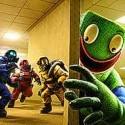















What do you actually do when the only working exit is the door the thing behind you is currently blocking? That’s the question Toilet 8 keeps asking, over and over, from the second you wake up flat on cold tile in a restroom that should be empty and isn’t. There’s no tutorial popup walking you through it, no weapon handed to you at the start, just a row of stalls, a door somewhere behind you, and a presence in the room that noticed you the moment you sat up.
| Genre | Horror survival |
| Platform | Browser (HTML5) / Windows |
| Perspective | First-person |
| Core Mechanic | Evade a stalking presence by moving between restroom stalls |
| Objective | Collect every sign in the restroom and get out before you’re caught |
Waking Up in a Restroom That Isn’t Empty
Toilet 8 doesn’t open with a cutscene explaining why you’re there. You come to on the floor of a public restroom, the fluorescent lighting doing that faint buzz that horror games love, and the first few seconds are just orientation — which way is the exit, how many stalls are open, is anything moving. Nothing happens immediately, which is worse than if it did, because the delay trains you to expect the room to stay quiet right up until it doesn’t.
The restroom itself is the entire map. There’s no hallway to retreat down, no second room to regroup in, just the stalls, the sinks, and whatever is sharing the space with you. That confinement is deliberate — Toilet 8 doesn’t need a sprawling level when the tension comes from how little ground you actually have to work with.
Most new players lose their first attempt within the opening minute simply because they move too much too soon, drawing attention before they’ve learned where the exit even is. The restroom rewards a slower first lap: stand still, listen, and only then start moving toward the stalls that look safest.
The Heartbeat That Tells You How Close It Is
Once you’re moving, the game’s only real interface is a heartbeat. It’s subtle at a distance and unmistakable up close, and it’s the single piece of information Toilet 8 gives you about how much danger you’re actually in. There’s no visible health bar, no proximity meter, no minimap ping — just your own pulse getting louder as the thing hunting the restroom gets nearer.
That design choice does a lot of work. Players end up making decisions off a sound cue instead of a UI element, which is exactly the kind of primal, gut-level feedback horror games chase and rarely land cleanly. When the heartbeat spikes while you’re mid-crouch inside a stall, you genuinely don’t know if it’s about to open the door or move past — and that uncertainty is the whole point.
It’s also the answer to one of the more common questions players ask before trying Toilet 8: no, you don’t get caught the instant it’s nearby. Proximity alone isn’t a death sentence. What actually gets you caught is staying in one stall too long after the heartbeat has already told you it’s circling back.
Ten Signs and Nowhere Safe to Read Them
The restroom’s exit condition runs through a set of signs scattered across the stalls and walls, and finding all ten is what actually lets you leave rather than just survive on a timer. An earlier version of Toilet 8 only asked for five, and a later update doubled that count, which noticeably stretched out a full clear and gave the stalking presence more total time in the room with you.
Reading a sign takes a beat of standing still, which is exactly the moment you’re most exposed. You can’t scan a sign while crouched and moving, so every one you collect is a small, deliberate risk — stop, read, and hope the heartbeat doesn’t spike while you’re doing it. Rushing signs without checking your surroundings first is one of the most common ways a run ends early.
Some players actually prefer clearing the restroom methodically stall by stall, treating the ten signs like a checklist, while others sprint toward whichever sign is nearest and improvise the rest — both approaches show up constantly in clips of people playing Toilet 8, and neither is clearly better once the chase actually starts.
Crouching, Throwing, and the Door That Won’t Stay Shut
Toilet 8 gives you exactly two ways to actively deal with the threat instead of just avoiding it, and both come down to fast reflexes rather than pattern memorization. Crouching lowers your visibility and quiets your movement, which matters most when you’re waiting out a pass rather than trying to outrun it — it’s a stillness tool, not an escape tool. Throwing whatever’s within reach is the other option, and it only really works at the exact moment a stall door swings open in front of you; thrown correctly, it buys a few seconds of space instead of a guaranteed getaway.
Neither option is reliable on its own. Crouching in the wrong stall just means being cornered quietly instead of loudly, and a badly timed throw wastes the one item you had in hand without actually stopping anything. The two mechanics only work together, and figuring out that combination — crouch to bait a door open, throw the second it does — is the actual skill Toilet 8 is testing.
This is also where the door mechanics themselves become a second source of tension on top of the chase. Doors don’t always open cleanly on the first try, and fumbling one while something is closing in has, by players’ own admission, scared them worse than the thing chasing them.
Toilets That Rat You Out
Not every hazard in Toilet 8 comes from the thing hunting you directly. Some of the toilets themselves flush when brushed against, and the sound carries straight to whatever’s listening for you. It’s a small detail that punishes careless movement inside a stall, and it turns even a “safe” hiding spot into something you have to navigate carefully rather than just duck into blindly.
That mechanic answers another question players commonly ask about the game: whether hiding in a stall is ever truly safe. It isn’t, not completely — between doors that can be opened, undersides that can be checked, and toilets that give away your position if you bump them, no single stall guarantees safety for long. The restroom is built so that every hiding spot has a flaw somewhere.
Learning which toilets are dangerous to brush past takes a run or two of trial and error, since nothing marks them visually ahead of time. Veteran players tend to give every stall a wide, deliberate path around the fixture itself rather than assuming a straight line to the door is safe.
Why the Chase Speed Update Split the Comments Section
An update that made the stalking presence noticeably faster is one of the more debated changes in Toilet 8’s history. Part of the community welcomed it as a fix for a version that had started feeling too forgiving once players learned the stall patterns; another part felt it tipped a fair chase into something closer to unavoidable, especially for anyone still learning the ten-sign layout for the first time.
That divide is honest and still ongoing — there isn’t a clean consensus on whether the faster pace made Toilet 8 better or just meaner. What most players agree on is that the change forced a shift in strategy: routes that used to allow a leisurely lap between signs now demand much tighter timing between each stop.
New players jumping in today are effectively learning the harder, post-update version by default, which is worth knowing going in — the game people describe from early clips and the game currently running behind the browser window aren’t quite paced the same.
Toilet 8 gets its tension from how little it actually gives you: a heartbeat instead of a health bar, ten signs instead of a marked objective, and a restroom with no safe stall guaranteed to stay that way. Whether you’re the type who clears every sign methodically or the type who bolts for the nearest one and improvises, the game keeps circling back to the same standoff it opened with — the door, the heartbeat, and the decision about whether this is the stall you finally stop moving in.
Comments
There are no reviews yet. Be the first one to write one.