















Vilmonic















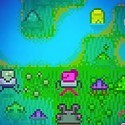
Vilmonic looks like a cozy pixel-art pet farm but plays like a genetics lab that never hands you a textbook. Every creature on screen grows from a genetic code, every pixel in its body carries meaning, and the world keeps running whether you understand it or not. If you came for a relaxed sandbox you will get one, but the game quietly rewards patience and curiosity from the very first minute.
| Genre | Artificial life simulator and evolution sandbox |
| Mode | Single-player |
| Goal | Bring life back from the brink of extinction |
| Life forms | Animatroids (anims) and fungols (fungs) |
| Hostile forces | Haywire zombitons |
| Achievements | 38 |
Reading Animatroids and Fungols Before You Touch Anything in Vilmonic
Life in this world splits into two groups. Animatroids, usually shortened to anims, are the creatures that move around, while fungols, shortened to fungs, are the plants and mushrooms that feed the rest of the ecosystem. Both are drawn as pixel bodies wrapped around internal bones or branches, and the way those bones bend comes straight from genes. A bigger body means more pixels, and more pixels means a bigger appetite. The shape you see on screen is the physiology you will have to feed.
Color matters just as much as shape. A fung’s hue is not decoration, because crafting recipes ask for specific colors.
Early in the game the smartest habit is to stop and watch. Anims carry external sensors for motion, scent, and water, plus internal sensors for hunger, stress, and thirst, and their brains connect those sensors through attraction and repulsion. That explains why one anim drifts toward water while another bolts away from your avatar. Nothing is scripted, and fear, aggression, and attraction all emerge from simple wiring. Players who like puzzle-solving tend to fall for this part, since every odd behavior has a traceable cause.
Artificial Selection: Turning Green Fungs Yellow in Vilmonic
Here is the lesson that trips up almost every beginner. Every life form reproduces asexually, so breeding does not mean pairing two parents; it means picking which individual gets to spread its genes. If you want yellow fungs, you find the yellowest of your green fungs, plant them around, and repeat that choice with each new generation. This is artificial selection in its plainest form. Nothing on screen labels it, which is why so many first-timers sit around waiting for a lucky mutation.
Colors drift along the rainbow, moving from red to orange to yellow, then green, blue, purple, and back around to red. Knowing that loop tells you which direction to push.
Patience is the real currency here. Evolution is slow by design, and a clean color shift can take many generations of picking and replanting. Collectors who love filling out catalogs will feel at home, because the game lets you export creature cards to share with friends. Lose track of your best lineage, though, and you may be restarting that selection chain from the very beginning.
Metabo Gene, Hydration, and Why Big Anims Starve
Every anim and fung runs on a metabolism that processes hydration and nutrients each cycle, and the pace of that cycle is set by the metabo gene. The numbers behind it are simple once you see them laid out.
- Large bodies need more hydration and nutrients every metabolic cycle, because each extra pixel adds to the bill.
- Wrinkled bodies expose more surface area, so they evaporate more water than smooth ones.
- A faster metabo gene processes supplies at a quicker rate, so reserves run down sooner.
Many deaths trace back to this math. A lineage that drifts toward bigger, more wrinkled bodies can look impressive and still wither in a dry corner of the map. Water access is often the fix, and you can dig a river with a shovel to bring it closer.
The learning curve is steep at this point, and the game rarely explains why a creature failed. That gap is why players lean on the community Discord and its pinned hints. Anyone who would rather terraform than tinker with genes can solve most of these problems by digging rivers and shaping islands.
Zombitons, Toxic Waste Barrels, and the Risky Side of Mutation
Once haywire zombitons start drifting through your world, the mellow pace picks up a little edge. These mindless, hostile life forms are the reason you cannot simply leave every species alone and walk away. Part of protecting your anims and fungs is keeping zombitons from overrunning them. The goal is to bring life back from the brink of extinction, so a lost lineage hurts more than a lost tool ever could.
Toxic waste barrels pull in the opposite direction. They drastically raise the mutation rate of offspring.
That makes a barrel a gamble. Crafted sugary drinks speed evolution up more gently, but a barrel can also wreck a lineage that took hours of careful selection, so keep a backup population of your best anims somewhere safe. Some players treat barrels as a shortcut for chasing a rare trait, while others call it cheating, and even the official description jokes about cheating with genetic engineering. Players who chase rare traits will find barrels very hard to resist.
Crafting a Gate: Shovels, Fiberoyd Boards, and Colored Fungs
Crafting is where color breeding pays off. The gate recipe shows colored mushroom slots, and those slots want fungs that closely match the colors shown. A gate needs a green fung, a yellow fung, and two fiberoyd boards, which are the fences.
- Pick the yellowest green fung in your garden.
- Plant its offspring somewhere you can find them again.
- Repeat with the yellowest fung of each new generation until a yellow one appears.
- Craft the gate with the green fung, the yellow fung, and two fiberoyd boards.
A shovel comes before any digging, so crafting one is the first practical step for rivers, islands, and relics. Ancient tech buried in the ground is part of the fun, although many finds turn out to be junk.
Long trips across your world get less tedious once you lay roads and use driving mode. It is a small quality-of-life touch, and it fits the relaxed tone of the whole sandbox.
Common Questions About Breeding and Surviving in Vilmonic
How do you get yellow fungs?
Pick the yellowest of your green fungs, plant its offspring, and repeat that choice each generation until a yellow fung finally appears. Green sits right next to yellow on the color loop, so you are only nudging the hue one step along the rainbow. Keep the best specimens separate so you do not lose progress.
What do you do when the infection warning appears?
The warning tells you to grow red fungols and craft a cola from them, so you need a red fung in your garden. If you have none, start selecting your existing fungs toward red, since the colors loop around the rainbow and every hue is reachable. Expect it to take several generations, so start early.
Why do my anims keep dying?
Metabolism is the usual culprit. Large, wrinkled bodies burn through hydration and nutrients quickly, and the metabo gene sets how fast each cycle runs, so check water access first. If supplies look fine, look for zombitons nearby.
Vilmonic rewards the player who watches an anim cross the map toward water, spots which fung is yellow enough for the gate recipe, and decides whether a toxic waste barrel is worth risking a favorite lineage. Few sandboxes make a single mutation feel this personal.
Comments
There are no reviews yet. Be the first one to write one.