
















Ultimate Tic Tac Toe












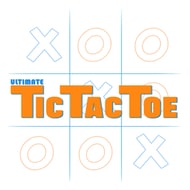
Ultimate Tic Tac Toe borrows the pencil-and-paper grid everybody abandoned after a dozen draws in third grade, yet a single match asks for the kind of foresight usually reserved for chess. The reason is a pointing rule: whichever square you mark inside a mini-grid tells your rival which mini-grid they are stuck playing in next, so each turn quietly chooses the battlefield for the following one.
| Genre | Turn-based abstract strategy |
| Core Mechanic | Every mark claims a cell and also points the opponent toward a specific mini-grid |
| Layout | A 3×3 arrangement of 3×3 mini-grids, 81 cells overall |
| Victory | Capture three mini-grids that form a straight line on the large grid |
| Players | Two at one screen, or one against a computer opponent |
One Move, Two Jobs in Ultimate Tic Tac Toe
Picture the large grid as a map of nine neighborhoods. Every neighborhood holds its own tiny tic-tac-toe contest, and the position of the cell you mark acts like an arrow: tap the lower-left cell of any neighborhood and your opponent is marched to the lower-left neighborhood of the map. In Ultimate Tic Tac Toe a move is therefore judged twice — once for the local fight and once for the location it forces on the other side.
Taking a mini-grid follows the familiar recipe of three matching symbols in a line. A captured mini-grid then behaves like one giant X or O on the large grid, and three captured mini-grids sharing a row, column or diagonal end the contest on the spot.
The rule most people misread on day one covers arrows that point at a closed neighborhood. When the destination mini-grid is already captured or has no empty cells left, the player being pointed there gets to drop a mark into any neighborhood that is still open. Regulars nickname this an open ticket, and gifting one to a rival is about the most expensive slip available, since it lets them choose the single cell that hurts you most.
Habits That Cost Early Matches
Tunnel vision is the classic rookie problem. A newcomer spots two of their symbols lined up inside one mini-grid, finishes the line with obvious satisfaction and only afterward notices the arrow from that winning cell marched the opponent straight into the central neighborhood, where a large-grid threat was already waiting. Capturing a mini-grid feels like progress, yet if the cell that captured it points somewhere dangerous, it can be the move that loses the whole board.
The second costly habit is forgetting which neighborhoods are already settled. Each closed mini-grid is a hidden trapdoor, because any arrow aimed at it hands out an open ticket. Players returning after a break often lose a match to exactly one careless mark that pointed toward a captured corner.
A short mental checklist before every move prevents most of this:
- Look at where the chosen cell points before judging its local value.
- Count the closed mini-grids — each one is a potential open ticket.
- Be stingy about sending the opponent into the central neighborhood early on.
- Value corner neighborhoods highly, since each one sits on three possible winning lines.
Steering Your Opponent Across the Grid
Strong players treat the arrows as a leash. Because every mark dictates the next destination, it is possible to keep an opponent bouncing between two or three neighborhoods where none of their options improve anything, while you build pressure elsewhere. The community phrase for this is herding, and plenty of matches between experienced players are decided by a long, quiet herd rather than a flashy capture.
Giving away a mini-grid deliberately is the idea that separates intermediate players from advanced ones. Sometimes the cell that surrenders a neighborhood also points the rival into a dead end, and that trade buys enough tempo to set up two simultaneous threats on the large grid. Anyone who plays chess will recognize the logic of sacrificing material for position, and those players usually pick up this side of the game faster than anyone else.
Forcing moves complete the toolkit. A mark that threatens to finish a large-grid line demands an answer, and if every possible answer points you toward a neighborhood you wanted anyway, you collect two benefits from a single turn.
The First Few Marks and the Center Argument
The opening move is the only fully unrestricted placement of the match: any of the 81 cells is legal. Many beginners grab the middle cell of the central mini-grid, which looks natural but immediately points the opponent back into that same central mini-grid and lets them contest it right away.
A large share of experienced players prefer starting in a corner cell of a corner mini-grid, sending the reply toward another corner and leaving the center undecided. A rival camp insists that early central presence outweighs the drawback. Neither side has convinced the other, and opening choice remains one of the most argued points among regulars.
What nobody disputes is that moving first carries a real edge. That imbalance is the most common complaint about the format, and it explains why serious pairs swap who starts after every match instead of playing a single deciding game.
House Rules Worth Checking in Ultimate Tic Tac Toe
Different versions of Ultimate Tic Tac Toe disagree about captured neighborhoods. Under one ruleset you may still place marks inside a captured mini-grid; those marks do nothing locally but still produce arrows. Under the stricter ruleset a captured mini-grid locks completely, and any arrow pointing at it becomes an open ticket.
A mini-grid that fills up without a line for either side causes a second disagreement. The common convention treats it as belonging to nobody, which blocks every large-grid line passing through it. Some house rules award it to whoever placed more marks inside. Spending one match against the computer to see which convention the current version follows avoids arguments later.
These differences matter because strategy guides written for one ruleset do not always survive the other. A herding pattern that works under locked-grid rules can collapse under open-grid rules, so testing a favorite trap before relying on it in a real match is a sensible habit.
Computer Opponent Versus a Friend on the Couch
The built-in opponent changes character a lot between difficulty settings. Lower settings hand out open tickets carelessly and leave captures lying around, which makes them a decent classroom for learning the arrow rule. Higher settings rarely miss a dangerous destination and seldom fall for an obvious double threat.
Two people sharing one screen is where most players actually get hooked. Casual players enjoy guessing what the other person is plotting, while competitive pairs start keeping tallies across long series of rematches. A single match usually wraps up within a few minutes, so an evening session can stretch to many games without anyone noticing the time.
Almost everyone who sticks with the game eventually lives through the same scene: the opponent captures a mini-grid with a little cheer, and the cell they used points you straight into the neighborhood that completes your large-grid line.
What Players Ask Before Their First Match
What happens when my arrow points to a neighborhood that is already closed?
Your opponent receives an open ticket and may place their next mark in any mini-grid that still has empty cells. Because that lets them choose the most damaging spot on the large grid, avoiding arrows toward captured or full mini-grids is one of the first habits worth building.
Does the player who moves first always win?
Moving first is a real advantage, but it does not guarantee anything between human players. Most matches are decided by a misjudged arrow or an accidental open ticket in the middle stages, not by the opening move itself.
How is this different from ordinary tic-tac-toe?
The ordinary version ends in a draw whenever both sides play carefully, while the nine-grid layout and forced destinations create a huge number of possible positions. You must capture mini-grids and then arrange those captures into a line on the large grid, which adds layers of planning the classic game never had.
Every mark you place points somewhere, and learning to read those arrows is what turns the 81-cell board from noise into a plan. Keep track of closed neighborhoods, avoid handing out open tickets and herd your rival into quiet corners, and Ultimate Tic Tac Toe starts rewarding patience the way a good strategy duel should.
Comments
There are no reviews yet. Be the first one to write one.
