















Townscaper


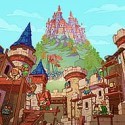










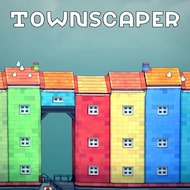
Townscaper looks like a city builder but plays like almost nothing else in that genre. There’s no population counter, no budget to balance, no failure state waiting to punish a bad decision — just an irregular grid, a palette of colors, and blocks that turn into houses the moment you set them down.
| Genre | Building toy / creative sandbox |
| Core Mechanic | Placing colored blocks that automatically resolve into buildings |
| Goal | None — the game has no win condition or objective |
| Best For | Players who enjoy relaxed, open-ended creative sessions |
Left-Click to Build, Right-Click to Undo
The entire input scheme in Townscaper comes down to two actions. A left click drops a colored block onto the grid, and a right click removes one. That’s it — there’s no separate tool for roads, stairways, or bridges, because the game generates all of that on its own based on how your blocks are arranged next to each other.
This is the part that surprises people most on their first session. Stack blocks a certain way and a staircase appears connecting them. Leave a gap between two clusters and a bridge fills it in automatically. Nobody is placing these elements directly — the underlying algorithm reads the shape you’ve built and decides what belongs there.
It sounds like it should feel random, but in practice the results are consistent enough that experienced players start predicting what a given block arrangement will turn into before they even place it.
Reading the Grid Before You Build on It
Townscaper’s grid isn’t a clean square lattice — it’s irregular, which is exactly why the towns it produces avoid looking like typical blocky city-builder output. That irregularity means the same cluster of blocks can look completely different depending on where on the grid you place it, since neighboring cell shapes vary.
Players who spend time in the game start treating the grid almost like terrain, noticing where a stretch of cells naturally lends itself to a canal or where a tight cluster is more likely to trigger a tall, narrow tower instead of a low sprawling building.
None of this is spelled out anywhere in the interface. It’s something you learn purely by placing blocks and watching what comes back.
What “No Goal” Actually Means Here
Most building games use a goal to give structure to your choices — hit a population target, balance a budget, survive a disaster. Townscaper strips all of that away, and the first session or two can feel disorienting without it. There’s no scoring, no failure state, no timer pushing you toward a decision.
What replaces the goal is a kind of open curiosity: placing one more block just to see what shape it produces. Sessions in the game tend to run longer than players expect precisely because there’s no natural stopping point built into the design.
Some players find this freeing and others find it aimless during their first few minutes. Both reactions are common, and it usually takes committing to one small town before the appeal clicks.
From Hamlets to Sky Cities on Stilts
The generator handles small clusters just as gracefully as sprawling builds. A few connected blocks on flat grid tend to resolve into a modest hamlet, while denser, taller stacking pushes the algorithm toward soaring towers and sky cities balanced on stilts above the water.
Canal networks come from a different approach entirely — leaving deliberate gaps of open water running through a cluster instead of filling every available cell. The generator treats those gaps as waterways rather than empty space, adding the small architectural details, like doorstep touches and rooftop decorations, that make each stretch of canal feel distinct from the next.
There’s a quiet satisfaction in watching a town shift character as you keep adding to it — a hamlet that slowly becomes a dense hillside settlement just because you kept clicking one more block.
The Small Details the Generator Adds on Its Own
What separates Townscaper from a simple block-stacking toy is how much detail gets layered on without any direct input from the player. Rooftops pick up small decorative touches, doorsteps get tiny accessories, and the overall town starts to feel lived-in despite nobody placing a single one of those details by hand.
A soft sound plays every time a block settles into the water, which is a small thing but adds to why extended sessions in the game feel calming rather than tedious. There’s no music pushing urgency, just the quiet rhythm of blocks landing.
Community discussion around the game tends to focus less on strategy — there isn’t really any — and more on comparing screenshots of towns, since the appeal is almost entirely visual and personal.
There’s no way to “finish” Townscaper, and that’s the point rather than an oversight. Whether you end up with a single quiet hamlet or a sprawling canal city with towers leaning out over the water, the appeal comes from watching the generator turn a handful of clicks into something you didn’t fully plan for — which is exactly why so many players describe losing an entire afternoon inside it without noticing.
Comments
There are no reviews yet. Be the first one to write one.