
















Tag











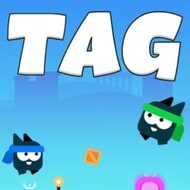
The arrow floating over a player’s head in Tag is the most important thing on the screen, and it does not stay in one place for long. Whoever is carrying that arrow when the countdown hits zero loses the round, so the entire match becomes a frantic effort to pass the arrow to someone else.
| Genre | Local multiplayer platform chase |
| Core Mechanic | Touch another player to pass the tagger arrow before the timer runs out |
| Players | Two people on one keyboard, or one player against a bot |
| Best For | Friends sharing a keyboard and quick competitive rounds |
Passing the Arrow in Tag
Each round drops the players into a compact platform map. One of them starts as the tagger, marked by the arrow, and a timer starts ticking. Touch an opponent and the arrow jumps to them; get touched and it comes back. The round ends when the countdown runs out, and the player holding the arrow at that moment loses.
Movement is simple — run, jump, drop through platforms — but the maps are full of ledges, gaps and walls that change how a chase plays out. Running in a straight line almost never works, because the chaser can cut across a lower platform and meet you at the other side.
The game feels best with two people on one keyboard, one using the letter keys and the other the arrow keys. Playing against the bot is useful for learning maps, but the real tension comes from a human opponent who reads your movement.
Maps, Power-Ups and the Space Between Them
Different maps change the flow of a match. Tight vertical layouts reward quick jumping, while wider maps with long platforms give the runner room to escape and make the tagger rely on shortcuts.
- Speed boosts let the runner open a gap or let the tagger close one in seconds.
- Jump boosts reach platforms that are normally out of range, creating escape routes nobody expects.
- Grabbing a power-up while holding the arrow is often the best way to force a pass in the last seconds.
Power-ups are also the most debated part of the game. Some players love the chaos, while others feel a well-timed speed boost decides too many rounds and prefer playing purely on movement.
Last-Second Tactics That Win Rounds
The final seconds of a round matter more than everything before them. If you are the runner, staying on the opposite side of a wall from the tagger is safer than running far away, because the tagger has to commit to one side and you can step around the other.
If you are holding the arrow, chasing directly is a mistake. Cutting off escape routes and waiting near a ledge the runner must use works far better, especially on maps with only one way between floors.
Competitive pairs end up memorizing every map’s choke points, and rounds between experienced players turn into short mind games where both sides fake jumps and switch directions mid-air.
Questions About Tag
Can I play Tag alone?
Yes, a computer-controlled opponent can take the second slot. It is good practice for learning maps and power-up spawns, although the bot is more predictable than a human chasing you around the same platforms.
What decides the loser of a round?
Only the arrow matters. Whoever carries the tagger arrow when the timer reaches zero loses, no matter how many times the arrow changed hands earlier in the round.
How do I escape a tagger who keeps cornering me?
Use vertical movement and walls. Dropping through a platform or doubling back over the tagger’s head is far more effective than running horizontally, and saving a speed boost for the final seconds can flip a round you were about to lose.
A speed boost, a fake jump and the arrow passing back at the last second can turn any round into a rematch request. That is the charm of Tag — a playground chase squeezed into a few platform maps and one floating arrow, where nobody is safe until the countdown hits zero.
Comments
There are no reviews yet. Be the first one to write one.
