















Agreeee














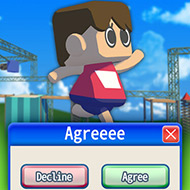
Agreeee takes a familiar piece of software behavior and turns it into a test of attention: before reaching the main action, you have to accept 12 terms of service. The catch is that the agreement screens are not passive menus. Each article can hide a different minigame, control trick, or timing challenge, and pressing Disagree sends the run back to the beginning.
| Genre | Puzzle and action minigame collection |
| Platform | Windows |
| Agreement stages | 12 |
| Core mechanic | Complete unusual terms-of-service challenges and reach the action section |
The 12 Articles in Agreeee
The opening sequence works because the player already knows how a terms-of-service window is supposed to behave. Normally, you scan for Agree and move on. Agreeee removes that expectation by turning the agreement process into a sequence of interactive obstacles where observation matters before the actual action game even starts.
Each article can demand a different response, so memorizing one universal trick is not enough. A screen may require timing, another may change the position of the controls, and another may present a familiar interface that behaves differently from what you expect. The game keeps forcing the player to read the situation again.
Players who are comfortable with puzzle games usually adapt by slowing down when a screen looks suspicious. Arcade players may initially rely on reflexes, but the agreement sequence repeatedly rewards checking the layout before acting.
Minigame Variety Inside Agreeee
The 12 articles contain more than 100 minigame-style challenges, and the range is intentionally broad. The collection includes ideas based on pinball, whack-a-mole, cooking, sniping, claw machines, pin-pulling puzzles, bullet hell, bomb defusal, slot machines, roulette, and command-based battles.
The variety creates a different difficulty curve from a normal game. You are not spending twenty minutes mastering one control system before the next level; you are repeatedly learning a new rule and then applying it quickly. That constant change is one reason a simple screen can become stressful after several successful articles.
There is also a clear parody element, with challenges drawing on recognizable ideas associated with games such as Flappy Bird, Breakout, Suika Game, Tetris, and Mega Man Battle Network. The references are most effective when the player recognizes the basic rule but has to adapt to Agreeee’s version of it.
Agree and Disagree Rules
The most important failure condition is unusually simple: pressing Disagree resets the process. That makes the agreement button more than a joke because every article becomes part of one continuous run toward the main game.
The safest strategy is to treat each article as a separate problem and avoid carrying assumptions from the previous one. A successful pinball section does not tell you anything about the next cooking or timing challenge. Players who keep their attention on the current screen tend to handle the variety better.
The reset rule can be divisive. Some players enjoy the pressure because it makes the legal-looking interface meaningful, while others may dislike repeating earlier articles after one mistake. Casual Mode softens that frustration by allowing retries from the same article and changing the minigame arrangement.
The Doki-Doki Action Game After Agreeee
Clearing the 12 agreement articles leads into the side-scrolling Doki-Doki Action Game. At that point the structure changes from a collection of short agreement challenges to a more conventional action sequence, creating a noticeable reward for getting through the intentionally awkward opening.
The main action section also includes ranking, so speed becomes relevant after the agreement sequence has been mastered. A player who only wants to see the content can focus on reaching the goal, while a competitive player has another reason to replay the route and improve completion time.
One recognizable moment comes when the player realizes that the boring legal screen was actually the first level. That reversal explains the whole design: the game is not asking you to read terms because the terms are important as legal text, but because the act of agreeing has been turned into the challenge itself.
How many terms are in Agreeee?
Agreeee uses 12 terms-of-service articles before the main action section becomes available. Each article contains an interactive challenge, so the player is effectively completing 12 stages of agreement-related minigames rather than simply clicking through a document.
What happens if you press Disagree in Agreeee?
Pressing Disagree causes the run to restart from the beginning. That makes the agreement sequence function as one continuous challenge, although Casual Mode provides a more forgiving way to retry from the current article.
What happens after the 12 articles in Agreeee?
After clearing all 12 terms, you can play the side-scrolling Doki-Doki Action Game. That section adds a ranking element for players who want to improve their completion time instead of stopping after reaching the goal.
Agreeee makes its 12 articles, constantly changing minigames, and unforgiving Disagree rule part of the same joke and challenge. Once the player reaches Doki-Doki Action Game, the strange agreement process makes sense as a deliberately extended first stage built around attention, adaptation, and refusing to click the wrong button.
Comments
There are no reviews yet. Be the first one to write one.