
















Mimic Busters
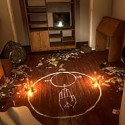
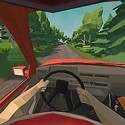
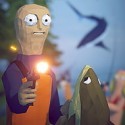



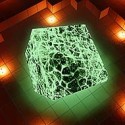
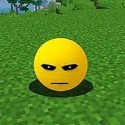

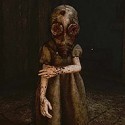

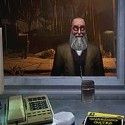
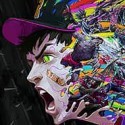


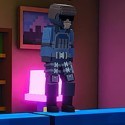
What do you do when your whole body is a cube and the Busters are already in the room? In Mimic Busters you do not run, you model. A few quick edits and a coat of paint turn you into something that looks like it belongs on the shelf, and the next 30 seconds decide whether anyone looks at you twice.
| Genre | Hide-and-seek with social deduction |
| Teams | Mimics and Busters |
| Signature tool | Simple 3D modeling and painting |
| Special modes | Guess the Mimic and a deathmatch-style mode |
| Platform | PC (Steam) |
Turning a Sentient Cube Into a Prop in Mimic Busters
Every Mimic starts the round as a plain walking cube, which is the worst possible disguise. The modeling tools are deliberately simple and intuitive: you push and shape the cube toward a prop you can see in the room, then paint it. Say there is a lamp in the corner. Your job is to copy its silhouette and its color closely enough that a Buster scanning the shelf does not stop on you.
The game promises that no modeling skills are required, and that is mostly true. If the Busters buy it, it is good enough. Beginners usually make the same mistake, though. They polish one side of the model for most of the round, then forget that Busters walk around objects and see every angle.
Players with a drawing or sculpting background do have an edge, because they read proportions quickly. But speed matters more than polish, since the timer keeps running while you work. A rough, correct shape beats a beautiful, wrong one.
There is a fair complaint here. Under time pressure the tools can feel fiddly, and a misplaced edit can ruin a half-finished model. Most players learn to commit to a simple shape early and add detail only if time is left.
Picking a Hiding Spot Before the Round Gets Loud
Early in a round, before the first squeak sounds, the Busters know almost nothing. That quiet window is when your choice of prop matters most. The best Mimics do not pick the prop that is easiest to copy, they pick the one that makes sense where they are standing. A cluster of similar objects is far safer than a single odd item on an empty floor.
Think like a Buster for a moment. They are looking for anything slightly out of place: a color that is a shade off, a shape with one wrong corner, or a prop that appears twice when the room only has one. Matching the prop exactly is not enough if the room does not need a second copy of it.
Patient players like to pick a spot, finish the model, and then stay still. Restless players tend to keep adjusting until the first squeak, and that habit often gives away the position. Once the squeak sounds, moving to a new spot is a gamble, and a half-finished model in the open is a much bigger risk than a finished one in the wrong place.
Big Models, MBI Agents, and the Points Gamble in Mimic Busters
This is where the game becomes more than a hiding contest. Mimics earn more points the bigger their model is, and they earn double points when hiding near MBI agents. So the safest disguise and the highest-scoring disguise are rarely the same thing.
A small model tucked behind clutter can survive a long time, but it scores little. A large model placed beside an MBI agent can earn a lot, but it is easier to see and sits in a place Busters naturally search. Competitive players tend to take that risk, while cautious players hide small and let the timer do the work.
- Small model: harder to spot, fewer points
- Large model: easier to spot, more points
- Near an MBI agent: double points, with more attention on your position
Players debate whether the big-model strategy is worth it. A surviving small Mimic still feels like a win, while a caught big Mimic can feel like a wasted round. There is no universal answer, and that tension is a large part of why rounds stay interesting.
Busters, Squeaks, and the Cost of Every Shot
Mimics squeak every 30 seconds, and that sound is the Busters’ main clue. By the time the second squeak sounds, a careful Buster has two data points and a rough direction. The squeak does not give an exact position, so Busters still have to look at the props themselves.
Every shot costs a Buster health, which makes spraying bullets at every suspicious object a bad plan. Observation matters more than reflexes here. A Buster who studies a prop for a few seconds and then fires once is in a much better position than one who fires at everything.
Social deduction also works as a quiet layer. Two Busters standing beside the same prop, neither shooting, is a tense moment, because each one is waiting for the other to commit. Mimics who notice that hesitation know they are close to being found, and it is often the cue to stay perfectly still.
Guess the Mimic and the Other Modes of Mimic Busters
Guess the Mimic flips the roles. One player is crowned the Mimic and secretly picks a word to model from several categories. Everyone else watches the shape come together and tries to guess what it is. Nobody is hunting, and the pressure comes from the clock and from how well you can model a word with simple tools.
It works well as a party mode, and it suits players who enjoy drawing-style games more than hunting. The same modeling tools are used, so time spent in Guess the Mimic also improves your speed in the main hunt.
There is also a deathmatch-style mode for players who want a faster contest with less hiding. It is not the heart of the game, but it gives groups a change of pace between hunts.
Common Questions About Mimic Busters
- Do you need modeling skills? No. The tools are designed to be simple, and a rough match is often enough to fool a Buster, especially if you pick a prop that already sits in a cluttered area.
- How do Busters find Mimics? They listen for the squeak that comes every 30 seconds and then study nearby props for anything that looks slightly wrong. Shooting costs health, so Busters need to be selective.
- How do Mimics earn more points? A bigger model scores more, and hiding near an MBI agent doubles the points. Both choices make you easier to find, so you have to decide how much risk you can handle.
Mimic Busters is at its best in the moment right after a squeak, when every Buster stops, turns, and looks at the same corner of the room. The cube you modeled, the MBI agent beside it, and the 30 seconds before the next squeak decide whether that stare ends in a shot or a miss.
Comments
There are no reviews yet. Be the first one to write one.
