















Rocket Pult










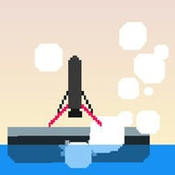
In Rocket Pult you start every run with nothing but a rocket, a launch angle you set yourself, and a sky that gets more crowded the higher you climb.
| Genre | Physics-based launch arcade |
| Core objective | Reach the highest altitude possible before your rocket is stopped |
| Controls | Click and drag to set angle and power, release to launch (desktop); tap and swipe (mobile) |
| Levels | Randomly generated on every run |
Setting Angle and Power Before Launch in Rocket Pult
Everything about a run gets decided in the second before you actually launch. Dragging further back builds more power, but power without the right angle just means slamming into the first obstacle faster instead of avoiding it. New players tend to drag for maximum power on every attempt, treating the launch like a race, when a gentler angle that threads between obstacles almost always climbs further than a brute-force blast straight up.
Since levels are randomly generated, there’s no fixed “correct” angle to memorize — every run demands reading what’s actually in front of the rocket before committing to the drag. That’s the core skill Rocket Pult is built around, more than reaction speed.
Birds, Trees, and the Sun as You Climb
The sky throws three recurring hazard types at you as altitude increases: birds that tend to cluster in shifting patterns, trees that jut up as fixed obstacles near the lower altitudes, and the sun itself, which can slow the rocket’s ascent if you drift into it. Trees are the most forgiving of the three since their position doesn’t change once a run starts, but birds move unpredictably enough that a safe gap can close by the time your rocket actually reaches it.
The sun behaves differently from the other two — it doesn’t destroy the rocket outright the way a tree collision might, but the drag it applies eats into your momentum at exactly the moment you need speed to clear whatever comes next.
Why Randomly Generated Runs Change Every Attempt
Because every level is generated fresh, no two runs of Rocket Pult play out the same way, which is part of the appeal but also a fair source of frustration. Some runs hand you a clean, wide-open climb; others stack birds and trees close enough together that a strong run gets cut short through no real misplay. Players who’ve logged a lot of time with the game generally accept this as part of the format rather than something to fight, but it’s a real criticism that comes up — a bad seed can undo good angle reading.
What separates strong runs from weak ones over time isn’t memorizing a layout, since there isn’t one, but getting faster at reading whatever the current run throws up in the half-second before launch.
Reading Altitude as Difficulty Scales in Rocket Pult
Early into a climb, obstacles stay sparse enough to launch fairly aggressively without much risk. Once you’re well past that opening stretch, hazard density picks up noticeably, and the same aggressive drag that worked fine near the ground starts sending the rocket straight into trouble. Score is tied directly to altitude, so there’s a constant tension between climbing fast for a higher score and playing cautiously enough to survive long enough to actually bank that height.
Casual players tend to play it safe the whole way through, favoring modest, repeatable climbs. Players chasing a high score usually push angle and power closer to the edge the higher they get, accepting more risk of a mid-run collision in exchange for a shot at a taller run.
What obstacles will you run into most often in Rocket Pult?
Birds, trees, and the sun are the three recurring hazards, with birds appearing in shifting clusters, trees sitting fixed lower in a run, and the sun applying drag rather than an outright collision.
Do mobile controls work differently than desktop in Rocket Pult?
Yes — desktop uses click-and-drag to set the launch angle and power, while mobile relies on tapping to launch and swiping to adjust angle, which changes how precisely you can fine-tune a shot.
Does altitude reached translate directly into your score?
Yes, your score in Rocket Pult is based on how high the rocket climbs before it’s stopped, which is why balancing aggressive angles against survival matters more than raw launch power alone.
Rocket Pult stays replayable precisely because the sky never sets up the same way twice — every drag of the launch angle in Rocket Pult is a fresh read on birds, trees, and the sun rather than a pattern you can simply memorize and repeat.
Comments
There are no reviews yet. Be the first one to write one.