















Bouncy Basketball
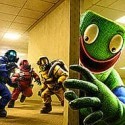















What actually happens when you hold the jump button a half-second too long right under the hoop in Bouncy Basketball?
| Genre | Physics-based sports arcade |
| Core objective | Outscore the opposing team before the final quarter ends |
| Controls | Space or D to jump and grab the ball, release to shoot |
| Match length | 1 to 4 quarters, each lasting 30, 60, or 90 seconds |
Grabbing and Releasing the Ball in Bouncy Basketball
Everything in Bouncy Basketball runs through one input: jump toward the ball to grab it, release to shoot. That single button does a surprising amount of work, because the game reads your position relative to the hoop and the ball’s arc when you let go, not just the fact that you released. Beginners tend to mash the button expecting more control than the game actually offers, when the better habit is reading distance first and timing the release second.
The button-mashing instinct is understandable — most sports games reward faster input — but here it works against you. A rushed grab near midcourt sends your player lunging past the ball instead of catching it, and a rushed release turns what should be an easy layup into an airball. Slowing down the first few possessions of a match pays off more than trying to out-tap an opponent.
It’s a genuinely divisive control scheme in the community. Some players love how much depth the game squeezes out of one button; others feel it makes outcomes too random, since a slightly early or late release can matter more than actual positioning. Both complaints show up regularly whenever the game gets discussed.
Dunking Timing Near the Hoop
Dunks are where the single-button system rewards precision most directly. Jumping close enough to the hoop while holding the ball, then releasing at the right instant, triggers a screen-shaking slam instead of a standard shot. The window for this is tighter than it looks; jump too early and you’ll release mid-air well short of the rim, jump too late and you’ll have already started falling before the release registers.
New players often try to force dunks from too far out, treating any jump near the paint as dunk range. Consistent dunking usually comes from getting close enough that the hoop is directly above your player before you even think about releasing, rather than jumping on approach and hoping timing lines up.
Once that timing clicks, dunks become the fastest way to close a scoring gap late in a quarter, especially in the tighter 30-second format where every possession counts more.
Choosing Quarters and Teams Before a Match
Before a match starts, Bouncy Basketball lets you pick between 1 and 4 quarters, each running 30, 60, or 90 seconds, plus a roster pulled from as many as 30 unlockable teams. Shorter quarters compress everything — there’s less room to recover from an early deficit, so aggressive early scoring matters more. Longer formats give more room to play patiently and let dunk timing and steals even out over the match.
Team choice affects pacing indirectly rather than granting outright stat differences you’d notice mid-possession; most of the variety comes from customizing which players and teams you’re facing rather than raw power gaps. Casual players tend to default to quick 30-second quarters for fast matches, while players grinding the Play Off mode usually favor the longer 60 or 90-second formats where consistency across quarters matters more than a single lucky dunk.
Picking a format before jumping in is worth the ten seconds it takes, since a 30-second quarter punishes slow starts far more harshly than a 90-second one does.
Stealing Possession and Reading Rebounds in Bouncy Basketball
Stealing the ball works on the same jump-and-grab logic as offense, which means defense in Bouncy Basketball is really about positioning your jump to intercept rather than reacting to the opponent’s shot. Jumping too early telegraphs the attempt and gives the ball-carrier room to release before you arrive; jumping right as they commit to a shot is the more reliable window.
Rebounds off a missed shot or a blocked dunk don’t always bounce predictably, since the physics engine adds a little randomness to every bounce off the rim. Players who treat every miss as a guaranteed second-chance grab get caught out here — sometimes the ball skips clean into the opponent’s hands instead.
Solo players facing the CPU will notice the computer reads these rebound bounces fairly aggressively, which makes stealing and boxing out near the hoop worth practicing even in single-player matches.
How do you steal the ball in Bouncy Basketball?
Time your jump toward the ball-carrier just as they commit to a shot rather than jumping early, since jumping too soon telegraphs the attempt and gives them room to release before you arrive.
Can you play Bouncy Basketball alone against the computer?
Yes, the game supports solo play against an NPC opponent in addition to two-player matches, and the CPU contests rebounds and dunk attempts aggressively enough that single-player matches stay competitive.
How many teams can you unlock in Bouncy Basketball?
Up to 30 teams are available to unlock and customize, giving matches variety beyond just the quarter length and format you choose before starting.
Bouncy Basketball keeps coming back to that one shared button — grab, release, grab again — and once dunk timing near the hoop and rebound reads start clicking, even a rushed 30-second quarter stops feeling like a coin flip and starts feeling earned.
Comments
There are no reviews yet. Be the first one to write one.