















House Of Hazards
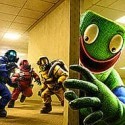













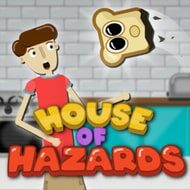
You reach for the finish line in House Of Hazards, and the player behind you flips on the iron sitting in your path — that single moment of chaos, more than anything else, is what the game is built around.
| Genre | Party / Multiplayer Chaos |
| Platform | Browser |
| Core Mechanic | Race through household levels while triggering hazards to slow down opposing players |
| Modes | Local multiplayer and single-player against bots |
House Of Hazards puts players in a cluttered house full of everyday objects that are secretly weapons: irons, toasters, roller skates, remote-control cars, and more, all scattered across a handful of rooms you need to race through. The twist is that most of these hazards do not trigger on their own — an opposing player has to physically activate them, which turns a simple race into constant, close-quarters sabotage.
New players tend to focus only on running forward and get blindsided by hazards they never saw coming, since watching your own path and watching what your opponents are doing behind you both matter equally. Ignoring the other players entirely is one of the fastest ways to lose a round, even if your own movement is clean.
Hazards as Weapons, Not Just Obstacles
Every hazard in House Of Hazards has its own trigger and its own punishment. The iron swings out and knocks anyone nearby off balance, the toaster launches a projectile across the kitchen, and roller skates left in a hallway send whoever steps on them sliding uncontrollably. Learning the layout of a level well enough to know exactly where these traps sit is the difference between reacting to chaos and causing it.
Timing matters just as much as placement. Triggering a hazard the moment an opponent enters its range is far more effective than triggering it early and hoping they walk into it later, since most players react fast enough to dodge a hazard they see coming from a distance. The best players in House Of Hazards bait opponents closer before springing a trap rather than firing at the first opportunity.
Levels That Escalate the Chaos
Later levels in House Of Hazards pack in more hazards per room than the early kitchen and living room stages do, which means the margin for a clean run shrinks fast. By the time you reach the more cluttered stages, nearly every path forward has at least one trap within reach of another player, so pure speed stops being enough on its own.
Aggressive players tend to spend more time triggering hazards on opponents than actually running, betting that sabotage wins more rounds than raw speed does. Defensive players play the opposite way, staying just far enough from others to avoid being an easy target while still making steady progress toward the finish. Neither approach dominates consistently, which is a big part of why matches stay unpredictable even between the same group of players.
What Keeps Matches Close
Comeback potential is a constant topic in discussions about House Of Hazards, since a player in last place can still turn a round around with one well-timed trap on whoever is leading. That same mechanic is also a common complaint, since a strong lead can evaporate from a single hazard that had little to do with skill, and reactions to that tradeoff are genuinely split within the community.
- Hazards must be manually triggered by another player to activate
- Later levels pack more traps into tighter spaces than early rooms do
- Baiting an opponent closer before triggering a trap outperforms firing early
Common Questions From New Players
Whether hazards can be avoided if seen early enough is one of the more frequent questions, and the answer is generally yes — most traps have a visible wind-up or an obvious object in the environment, so players who scan ahead rather than just sprinting forward avoid a large share of them. Another common question is whether bots behave the same as human opponents in single-player mode, and while bots do trigger hazards, they tend to do so less strategically than a human player baiting a trap on purpose. A third question that comes up often is whether it is better to prioritize speed or sabotage, and the honest answer depends on the level — tighter, hazard-dense rooms usually favor sabotage, while open stretches favor just running.
Between the iron swinging out at exactly the wrong moment and the last-place comeback that nobody saw coming, House Of Hazards turns a simple house race into something closer to a slapstick fight, and that unpredictability is exactly why matches rarely play out the same way twice.
Comments
There are no reviews yet. Be the first one to write one.