















X-YZE
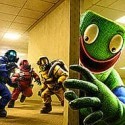















You slam into a daemon because X-YZE gives you no attack button, and the attack gauge climbs with every bump you land. Then one careless touch from anything in the room drops the gauge to zero, and the damage you were building disappears. That loop of ramping up, getting clipped and starting over defines the game, and you feel it within the first two minutes. Anyone expecting a button-based brawler finds out fast that every fight here is a question of where you stand rather than what you press.
| Genre | Bump combat action |
| Structure | Mostly linear servers, each ending in a boss fight |
| Playtime | Roughly 2 to 4 hours for the campaign |
| Extras | Unlockable arcade mode with server and boss practice |
Bump Combat and the Attack Gauge in X-YZE
Walking into daemons is the only way to attack, which sounds limiting until you see how much positioning it demands. Every approach is a commitment, because the attack gauge rises with each hit and a single touch from a daemon wipes it clean. Diagonal movement is faster than straight movement, a quirk the game openly keeps, and players lean on it constantly to close gaps and cut corners.
Beginners almost always charge into a cluster and trade hits, then wonder why their damage never climbs. The fix is patience: pick one daemon, land several bumps in a row, and back out before its pattern comes around again.
Early in the game, before the dash unlocks, servers lean on plain walking speed and that diagonal trick to teach spacing. Once dash arrives it works as much for offense as for escape, letting you cross a gap, hit and leave in one motion. Players raised on old shmups tend to settle in faster, since daemon patterns reward reading lanes and timing your entries.
Servers, Daemons and Bosses Inside X-YZE
Servers are the levels, and most of them run in a mostly straight line with their own daemon types and hazards. Each one closes on a boss fight, so you always know a real test is waiting at the far end. The structure keeps the campaign tight instead of sprawling.
Daemons are the non-boss enemies, and the roster has plenty of personality, with Drillady coming up often when players compare favorites. Spikes and switches join them in some rooms, so you end up reading terrain and enemy patterns at the same time.
Bosses are where players tend to gush. The Arbiter fight gets singled out for a twist that ties into the surrounding server, and the final boss earns praise as an inventive puzzle that is a blast to learn.
Where the Difficulty Spikes and What Helps
Players regularly point to the third server as a noticeable jump in difficulty, and some of the later sections get chaotic enough that the default challenge feels steep. A common complaint is that save points could be a little more frequent, since a death late in a long room can cost real progress. That is a fair criticism, and it is the kind of thing that decides whether someone finishes or quits.
One dark server hides most of the layout, so the floor, spikes and switches are hard to read, especially on certain monitors and capture setups. A setting that boosts the brightness of the dark background was added to address it, and turning it on is worth it if you squint.
Gameplay settings and easy mode options let you soften the challenge, and at least one player with wrist strain finished the campaign comfortably thanks to them. Story-first players should also know the plot touches heavy themes, and the content warnings on the store page are worth reading before you start.
Arcade Mode, Practice and Boss Rush
Arcade mode is unlockable, and it includes server practice and boss practice, which makes it the place to grind a fight you keep losing. Finishing a server there feels different from the campaign because there is no story pacing between attempts, only the daemons and your routing. Speedrunners tend to settle here, and a run under one hour is viable.
A boss rush is also part of the package, stacking the fights back to back so the attack gauge and dash habits you built get tested without a breather. It is a good way to see how much of the campaign has stuck.
The story is a short mystery of about 3,000 words, delivered in small doses throughout and between servers rather than in long cutscenes. Players who skim dialogue can skip text with Esc, while those who read every line get a campaign that lands closer to the four-hour end of the range.
Quick Answers for New Players
How long does X-YZE take to beat?
The campaign runs about two to four hours depending on playstyle and on how often the third server sends you back to a checkpoint. Arcade mode can be cleared in under an hour once you know the servers and the boss patterns.
Can you lower the difficulty in X-YZE?
Yes, the game includes easy mode options and gameplay settings that adjust how punishing the servers feel. There is also a brightness setting for the dark server background, which helps when spikes and switches blend into the floor.
Why does my attack gauge keep dropping?
Any single hit from a daemon resets the gauge, no matter how full it was. Use dash to disengage the moment a pattern turns toward you, and re-enter from a diagonal so you can rebuild the gauge before the next strike.
X-YZE rewards players who treat every room as a spacing puzzle, from the first Drillady encounter to the Arbiter fight and the last boss. The attack gauge punishes greed, the dash rewards nerve, and the difficulty options mean that a rough third server does not have to end your run. If bump combat with a story you can finish in an afternoon sounds appealing, this game is built for exactly that.
Comments
There are no reviews yet. Be the first one to write one.